|
|
| City College Library of The City University of New York | no.52 (n.s.) Fall 1996 |
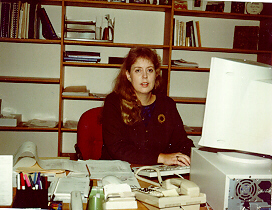
City's New Chief Librarian
 n mid-August the City College welcomed its new Chief
Librarian, Pamela Gillespie. She succeeds Professor Ruth
Henderson who served four years as Acting Chief Librarian.
Professor Gillespie most recently served as Hunter College's
Associate Librarian for Systems and Technical Services. She has a
background in computer systems, cataloging, NOTIS management (the
CUNY libraries' online system), electronic publishing, and
collection development in Computer Science and Hebrew and Jewish
Social Studies.
n mid-August the City College welcomed its new Chief
Librarian, Pamela Gillespie. She succeeds Professor Ruth
Henderson who served four years as Acting Chief Librarian.
Professor Gillespie most recently served as Hunter College's
Associate Librarian for Systems and Technical Services. She has a
background in computer systems, cataloging, NOTIS management (the
CUNY libraries' online system), electronic publishing, and
collection development in Computer Science and Hebrew and Jewish
Social Studies.
 Raised
in Texas, Professor Gillespie earned a B.A. in Journalism from
Trinity University, San Antonio, an MS Ed. from Baruch, and an
M.S. in Library Service from Columbia. Recently Circumspice's
editor and Professor Gillespie discussed academic librarianship
today and her specific plans for the City College Library.
Raised
in Texas, Professor Gillespie earned a B.A. in Journalism from
Trinity University, San Antonio, an MS Ed. from Baruch, and an
M.S. in Library Service from Columbia. Recently Circumspice's
editor and Professor Gillespie discussed academic librarianship
today and her specific plans for the City College Library.
Ed. How will academic libraries best serve
their constituencies today?
P.G. I think of public higher education in NYC
as serving a clientele different from academia as a whole. Look
at the user population. It's not upper-middle class. The finding
that 54% of CUNY students have computers in the home is skewed;
it's not that high here. We're providing information access and
resources to a clientele that does not have such information at
its fingertips. The library is their link to the information
universe - printed as well as Internet access. We are the gateway
to the printed word, to resource access in-house and globally.
Ed. Are librarians' roles changing?
P.G. Absolutely. The librarian is less a keeper
of materials and more of an information resource expert. The
librarian should be a facilitator for access to research
materials and information wherever they reside. The role of the
information professional is to guide the access in an appropriate
way for whatever level of information, whether she pulls a book
off the shelf, sends the student to the stacks, or finds an
obscure resource now on the Web. Librarians will be less experts
and more facilitators. They have a unique breadth of knowledge
and expertise to get to a question's substance and guide the
questioner to appropriate resources to answer it. They have the
critical thinking skills that make this exchange work. I see the
librarian as the 21st century equivalent of a Renaissance
man/woman.
Ed. What is a Chief Librarian's role in the
continuing education of the staff?
P.G. My role is to encourage and assist in any
way I can, not solely financial because that's difficult, but to
find opportunities for professional development and to make sure
that people to whom they apply are aware and are given the
opportunity to take advantage of those opportunities.
Ed. Do you see changes in the roles of the
support staff?
P.G. There's a professionalization of this
support - a lot of the standardized processes, e.g. materials
processing, acquisitions, are now being managed by professional
support staff, many of whom have college degrees. This is
appropriate because they have the specialized training which
allows them to be effective and comfortable in these roles and to
provide a high caliber of service. I wish we could reward this
service more.
Ed. What's been your first order of business?
P.G. Expanding library hours - opening Sundays
during the semester in the Cohen and Sci/Eng Libraries. I did
this because of two impressions. The first was the number of
City's students who used Hunter's library on Sunday. There was a
need. I also saw the tremendous number of students in our
libraries during the week - it seemed possible that we'd have a
good turnout on Sunday as well. Also, it's a different place from
Hunter. There, many students run in, photocopy, and leave. Here,
students stake out their space and stay for a significantly
longer time.
Ed. What do you hope to change or introduce
your first year?
P.G. I'll expand the library's instructional
program - more classes within departments, expanding the teaching
role of librarians. We'll do more subject specialization
instruction geared to students' research interests. We're
upgrading the technical infrastructure and streamlining some of
our services such as Interlibrary Loan and Document Delivery.
Ed. Is it important to increase the library's
visibility?
P.G. I don't think you can ever do too much PR.
It's important to point out to people what's different as time
goes by. In every forum I've been to, I've mentioned that hours
have expanded. I'd like to make sure that when I introduce a new
service or facility, it's well publicized. People shouldn't find
out about things serendipitously, especially in terms of
services.
Ed. What about budgetary constraints?
P.G. I don't see dramatic budget improvement
until enrollment figures improve, and even then it will be a
small increase. We must be more aggressive in looking for
alternate financing - get off the campus and start pitching where
other institutions are looking for funds. It's very competitive
out there, but with properly structured, realistic proposals, we
can get alternate funding. We'll focus too on maximizing
on-campus funding sources. Another funding avenue to scrupulously
cultivate is the Friends of the Library. I hope to increase its
activities, membership, and visibility. We all gain in having an
active Friends group.
Go
to next page 
